Microsoft Ignite 2025 - first time in the US, and everything is big
Microsoft Ignite 2025 ran 18–21 November in San Francisco - my employer’s delegation from Europe, and my first trip to the United States. I had been abroad plenty for work and holidays; Japan is still the place I would fly back to with no agenda. Westbound travel is always easier on jet lag for me; eastbound is worse. Landing in Japan was the rough part. San Francisco outbound was fine - the bad stretch was the flight home to Poland. Crossing the Atlantic was new either way.
Until then my mental map of America came from TV, films, and games - especially the Grand Theft Auto series. San Francisco was finally a chance to see whether San Fierro had any basis in reality. The hills and cable cars did. The wanted level did not.
Everything in the US looked scaled up. Distances, the Moscone halls, the badge pickup lines. Food too - one morning my colleague and I ordered a single milkshake to share after breakfast, already almost full. The server brought a glass and the rest in the shaker it was mixed in. We had both assumed one order meant one modest glass. That was when “American portions” stopped being an abstract joke. Ignite itself matched that - tens of thousands of people, more tracks than any sane person could follow, and announcements that only make sense when you are standing in the middle of the noise.
Opening keynote at Chase Center
The opening keynote and the partner session that followed were not in Moscone. They were at Chase Center - home of the Golden State Warriors - and the size of the room hit me before the slides did. I had watched Ignite keynotes online for years; seeing the stage mechanics in person was a different thing. While one part of the stage was live, crew and equipment were already set up on the next segment behind the curtain. On a livestream that looks like a clean cut; in the arena you notice how much rehearsal and choreography sits behind a ninety-minute story.
Judson Althoff led the opening (Satya Nadella was not on stage this year). The message I took away was less about a single shiny demo and more about Microsoft lining up agentic AI, security, and the commercial stack under one narrative - which set up the product news that followed.
Microsoft Foundry and the Frontier line
I had been waiting to see how Microsoft would simplify the Azure AI naming maze. Ignite answered with Microsoft Foundry - Azure AI Foundry folded into a broader brand, with Azure OpenAI resources able to move across without throwing away endpoints and keys. After months of everything in the industry being described as “frontier,” it was useful to see that language show up in a coherent platform story: one place for models, agents, governance, and the tooling that connects them to M365 and the rest of the stack - not another portal with a different logo.
I work on that stack daily for customers. The rebrand is not magic, but it matches what teams already struggle with: too many entry points, too many API shapes. Foundry is Microsoft betting that consolidation matters more than one more SKU name.
Our booth - Databricks landing zone on Azure
We had a partner booth on the expo floor. I spent time there talking about Databricks Landing Zone on Azure - an offering I had been helping build in the months before Ignite: opinionated Azure landing patterns for Databricks estates, the kind of thing platform teams want before data engineering scales past a single workspace.
It is not in Azure Marketplace yet; publication is still in progress. Longer term it may become one of our standard packages for customers who want a governed starting point rather than another bespoke Terraform repo. For the conference it was enough to explain the problem - identity, networking, Unity Catalog hooks, repeatable deployment - and show the slide loop on the screen behind us.
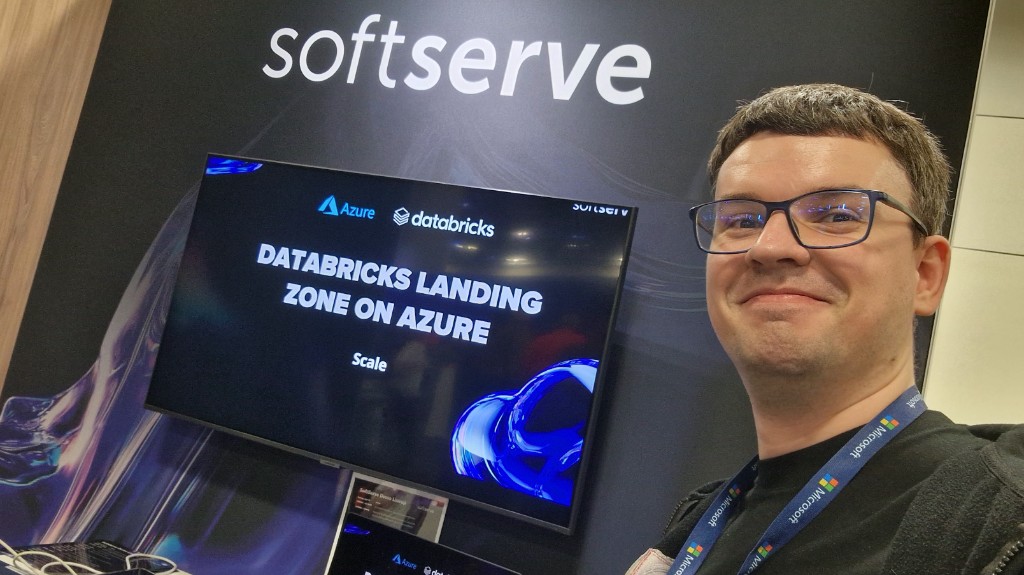
Partner booth at Ignite 2025 - Databricks Landing Zone on Azure
Sessions and labs
I bounced between breakouts for most of the week - security, platform, AI ops, the usual Ignite spread. The scale is overwhelming in a good way: whatever niche you care about, three sessions clash with it.
The talk I keep sending people to is Scott Hanselman and Mark Russinovich’s Scott & Mark learn to connect the dots - a deliberately silly, demo-heavy walk from the Altair 8800 through BASIC, early networking, and Zork, all the way to running the same idea on Azure at ridiculous scale. It is not a tutorial; it is a reminder that today’s platform problems rhyme with 1975 boot loaders and single-user machines. Recording on YouTube if you want the full hour.
For hands-on work, ignite25-LAB517 - next-gen AKS with agents and MCP - was the one worth the seat: agents on Kubernetes, models, operational wiring, not a slide-only AI story.
I also sat the beta for Microsoft Certified: AI Transformation Leader on site, with no preparation time. More on that below.
Same stadium, different sport - Friday night
On Friday, 21 November, I went back to Chase Center for basketball instead of keynotes. The Warriors hosted Portland in an NBA Cup group game: Golden State 123, Portland 127. Stephen Curry put up 38 points and kept it close late; the home team still lost, but barely - the kind of finish that makes a neutral visitor feel they got their ticket’s worth. After a week of standing on concrete expo halls, watching a stadium do what it was built for felt right.
Update - mid-February 2026
The beta exam result landed later: I passed Microsoft Certified: AI Transformation Leader. Glad I took it at Ignite even without prep - the syllabus maps closely to the conversations customers are already having, which is probably why the beta worked as a pulse check.
Thanks to my employer for the trip, and especially to colleagues in the Cloud & DevOps Practice EU who held the fort while a few of us were on Pacific time. I hope Ignite 2026 is on the calendar again next year.